 by Heidi
Daily Briefing
18 articles
Neutral (0)
by Heidi
Daily Briefing
18 articles
Neutral (0)
AI News Briefing for July 28, 2026
A curated roundup of the most relevant AI industry developments from verified source articles.
Digest headline: AI News Briefing for July 28, 2026
Total articles: 18 • Images available: 5 (images anchor the living gallery)
Security tools that speak softly and carry a big firewall
Microsoft’s latest AI security suite—trodden into Ars Technica headlines as cost-efficient yet formidable than its rivals—promises a line item in every SOC’s budget with a quieter, more decisive punch. The briefing today zooms into what “outperforming” means in practice: cheaper licensing, tighter telemetry, and a posture that scales with model-risk sophistication. In a landscape where attackers adapt faster than dashboards update, the promise of lower cost and higher guardrails is not merely currency; it’s a shift in strategy. How enterprises integrate, audit, and govern these tools will reveal whether the headline’s bravado translates into durable resilience or just a clever inflection point.
Policy lines crossed: Starlink’s router exemption and the politics of hardware in flight
The Starlink exemption from a FCC router ban—anchored in a Texas factory and a footprint that traverses Vietnam—reads like a case study in tech-policy gymnastics. The briefing peers beyond the headline: what does it mean for global supply chains, security vetting, and the delicate geometry between national interest and market access? As SpaceX bets on a distributed, patchwork architecture of hardware and software, the page-turner is not just regulatory relief; it’s a blueprint for how policy can recalibrate the tempo of innovation when globalized hardware meets domestic risk thresholds.
Analytics, health, and the cautionary geometry of AI in public safety
An extraordinary juxtaposition sits at the meeting of nutrition, public health, and AI analytics: an outbreak that reshapes consumer behavior as much as it informs policy. The dish is simple but powerful—data-driven signals guiding safety, with the caveat that models misinterpretation can ripple outward. This panel asks: when AI interprets health data, where does rigor end and overreach begin? The implication is not merely operational but existential for trust, traceability, and the governance scaffolds that must hold steady when real lives turn to risk indicators on a dashboard.
A horizon of bridges: OS updates as gateways to the AI-enabled enterprise
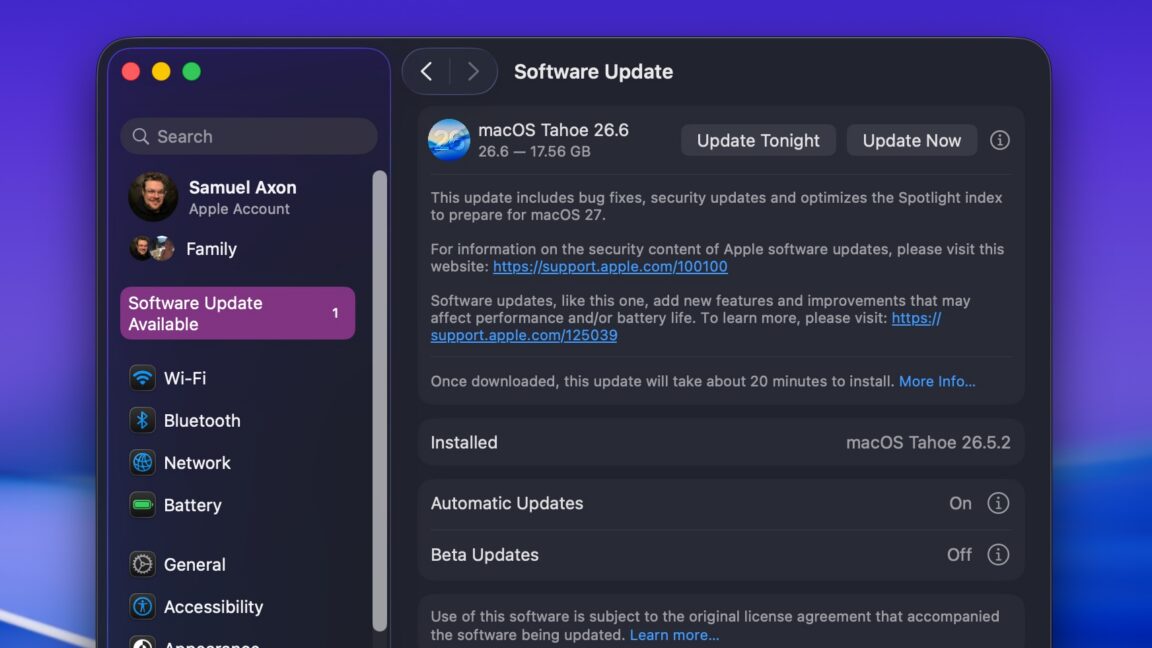
iOS 26.6 and macOS 26.6 arrive like a prelude to iOS 27 and macOS 27—framing a narrative where operating systems are not just vehicles for apps, but rails for AI-driven workflows. The briefing tracks how these updates recalibrate developer expectations, security postures, and the human-machine interface at scale. The last notable releases before Apple’s fall lineup become less about features and more about a strategic stance: a platform’s readiness to host, govern, and bias-correct intelligent agents as a core capability, not an add-on.
When a single symbol betrays due process: the underscore that changed a life
The grim parable of a missing underscore in a policy trigger that led to a man’s 18-month prison sentence casts a brutal light on automation’s failures. The room for error widens when human scrutiny slips and the system operates at speed with insufficient checks. This panel doesn’t merely recount a misplaced character; it interrogates the fragile interface between policy strings, law enforcement workflows, and the civilization-scale stakes of AI-assisted decisioning. It is a reminder that the spell of automation requires a counterspell of humility, auditing, and human oversight.
Answerwatch – Track changes in what AI models recommend
A focused briefing around Answerwatch, a GitHub-hosted project that traces how AI models shift their recommendations over time. The conversation sits at the intersection of governance and transparency: a quiet but vital probe into model drift, alignment drift, and the incentives that shape what gets recommended and what gets forgotten. The Hacker News entry signals low engagement, yet the implications for auditability and responsible ML governance are anything but trivial. For teams baking governance into product lifecycle, Answerwatch is a bellwether—an invitation to observe, quantify, and report the evolution of counsel from our own AI systems.
Source: Hacker News – AI KeywordHow AI and Low-Latency Computing Are Reshaping Digital Twins
The piece surveys a landscape where AI-driven decisioning converges with ultra-fast data pipelines to tighten the loop in digital twins. Real-time insights, edge computing, and industrial IoT rewrite what a ‘twin’ can do—from predictive maintenance to autonomous operations. The piece foregrounds a future where model inference lives at the edge, reducing reaction time and network latency, while raising new questions about data governance, security at the edge, and the quality of live simulation in mission-critical environments.
Source: Hacker News – AI KeywordShow HN: Krate, AI-made apps as permissioned files for Mac, Windows, and Linux
Krate presents a vision where AI-generated apps are distributed as permissioned files across major OS ecosystems. The concept hints at a future where AI-assisted packaging and governance mechanisms make software provenance a first-class concern, potentially simplifying trust boundaries while raising questions about persistence, sandboxing, and cross-platform security policy. The conversation around “permissioned-files” touches on the broader risk calculus of AI-enabled software delivery.
Source: Hacker News – AI KeywordHow I use AI in my geology research without losing the science I love
A geologist details how AI can enhance analytical rigor without compromising scientific method. The narrative leans into disciplined data handling, methodological transparency, and the careful separation of hypothesis generation from hypothesis testing. In fields where data volume is exploding, AI becomes a collaborator—yet a collaborator that must be held to the standards of reproducibility, traceability, and skeptical replication that define credible science.
Source: Hacker News – AI KeywordAI Makes Starting Games Easier. Finishing Is Still Hard
The paradox of toy-breakthroughs: AI reduces the friction of starting games, yet completion often remains a stubborn hurdle. The conversation blends game design, iterative AI tooling, and where automation ends and human craftsmanship begins. The best practice here is not to chase a single magic button but to architect a pipeline that nudges players toward sustained engagement, balancing novelty with meaningful endings that reward long-tail play.
Source: Hacker News – AI KeywordShow HN: Drever – AI-first MDX presentations with expressive motion
Drever envisions a future where AI-infused MDX storytelling embraces motion as a core expressive medium. The piece teases new paradigms for presenting complex data—where narrative flow, data visualization, and algorithmic pacing converge. The underlying tension: how to preserve interpretability and audience comprehension when motion carries interpretive weight, not just aesthetic flair.
Source: Hacker News – AI KeywordVibotify – Talk to 300 AI experts, one for every profession
Vibotify proposes a massive, profession-specific AI expert network. The promise is breadth of specialization—an economy of counsel from clinical to creative domains. The briefing weighs the operational realities: curation, quality control, and the risk of echo chambers in expert advice. It asks what governance structures ensure that “expert” AI counsel remains diverse, accountable, and aligned with human decision-makers.
Source: Hacker News – AI KeywordHow to choose an AI Agent platform for your team
A grounded guide to selecting an AI agent platform for teams, emphasizing interoperability, governance, security, and scalable adoption. The piece maps decision criteria—APIs, control planes, cost models, vendor support—against organizational realities such as regulatory requirements and existing tech stacks. For teams wrestling with deployment risk, the article offers a pragmatic checklist to separate hype from durable capability.
Source: Hacker News – AI KeywordProfessor Creates Midterm Trap to Catch AI-Assisted Cheating
An education-focused incident spotlights the tension between AI-enabled tools and assessment integrity. The story, sourced via Today.com and Hacker News, raises questions about how educators can deter cheating while maintaining fairness and learning value. It’s a testbed for policy design—where prompts, proctoring, and pedagogy converge to define acceptable AI use in the classroom.
Source: Hacker News – AI KeywordShow HN: Orchard – Let AI agents set up your app's back end with one prompt
Orchard showcases a provocative promise: single-prompt orchestration of backend setups by AI agents. The implications for developer velocity, reliability, and security are non-trivial. The article invites us to consider how far automation can go in building robust service architectures while still requiring human oversight, validation, and incident response discipline.
Source: Hacker News – AI KeywordCursor makes its biggest India push yet ahead of SpaceX acquisition with localized pricing
A strategic expansion into India—its third-largest market—frames Cursor’s growth alongside a global strategic pivot toward SpaceX-era scale. Localized pricing, hiring, and enterprise sales illustrate how AI-enabled platforms scale across geographies while navigating regulatory environments, talent availability, and competitive alignment with global giants. The piece signals not just market share but the architecture of a multinational AI stack molded for diverse compliance regimes.
Source: TechCrunch AIAnthropic’s Dario Amodei responds: doesn’t oppose open-weight models, but fears Chinese AI
Anthropic’s leadership signals a nuanced stance on openness and geopolitical risk. The dialogue centers on open-weight models, safety, and the strategic anxieties surrounding rapid Chinese AI development. The piece invites readers to consider how governance frameworks balance openness, security, and international competition when model architectures cross borders and policy lines become contested terrain.
Source: TechCrunch AIMicrosoft unveils AI security tools it says outperform competing platforms
The Ars Technica briefing on Microsoft’s new AI security suite spotlights claims of cost advantage and performance leadership. The narrative here tracks how security tooling can move from boutique add-ons to mission-critical, enterprise-grade fundamentals. The considerations span incident response velocity, cross-tool integration, and the governance overhead that comes with commoditized AI-enhanced protection. The underlying question remains: will buyers reward performance metrics or perceived simplicity in security toolchains?
Source: Ars TechnicaTrump admin exempts SpaceX's Starlink from FCC ban on foreign-made routers
A policy moment where politics, manufacturing, and global supply chains collide. Starlink’s router exemption underscores how tech-policy maneuvers shape a horizon of domestic resilience and international risk—particularly when the product chain spans multiple continents and regulatory regimes. The piece invites readers to watch for how such exemptions influence deployment strategies, vendor diversity, and national security calculus in a rapidly expanding satellite internet ecosystem.
Source: Ars TechnicaSatya Nadella says companies that trust one AI for everything may not survive
Nadella’s warning reframes the AI-adoption playbook: a world where a single model becomes a fragile capstone rather than a robust layer. The discussion points to a guardrail concept—AI gateways and layered infrastructure—that separates prompts from models, enabling governance, containment, and diversified risk. The broader inference: enterprise AI requires system architecture that preserves control, modularity, and resilience in a landscape of volatile models and shifting policy norms.
Source: TechCrunch AIEpic diarrhea outbreak has 40% of Americans avoiding fruits and veggies
A health scare reframed by data: nutrition experts critique the narrative around safety and AI-assisted analytics as it intersects with public health messaging. The piece, grounded in a CDC/FDA context, reminds readers that data interpretation, public communication, and timely corrective actions must stay vigilant against misinterpretation—especially when AI-generated insights enter consumer behavior, policy advisories, and food-safety decision trees.
Source: Ars TechnicaiOS and macOS 26.6 arrive today, paving the way for iOS and macOS 27
Ars Technica maps a maintenance-to-vision arc: today’s updates are a bridge to the next generation of Apple platforms. The discussion centers on how these releases set the stage for deeper AI integration, developer tooling, and platform governance. As Apple’s ecosystem expands its AI-friendly toolkit, the implications ripple through app economies, enterprise deployment, and the delicate balance between privacy and intelligence in consumer devices.
Source: Ars TechnicaA missing underscore sent innocent man to prison
A cautionary tale from policy, law, and algorithmic missteps. The underscore, a single character, becomes a catalyst for a misfire in automated decision workflows with profoundly human consequences. The piece invites reflection on safeguards: human review loops, robust auditing trails, and the irreducible need for context in automated enforcement. It’s a visceral reminder that speed without scrutiny can end with someone’s liberty on the line.
Source: Ars TechnicaSummarized stories
Each story in this briefing links to the full article.
by Heidi


 by Heidi
Heidi summarizes each daily briefing from trusted AI industry sources, then links every story back to a full article for deeper context.