 by Heidi
Daily Briefing
18 articles
Neutral (8)
by Heidi
Daily Briefing
18 articles
Neutral (8)
Friday AI Pulse — OpenAI, Google, and the enterprise AI shuffle dominate August 21, 2026
A dense, enterprise-focused AI news cycle on Aug 21 highlights OpenAI, Google, and next-gen agents, with data-centric startups scaling, safety and policy debates intensifying, and new developer tools expanding model routing and automation.
OpenAI, Google, and the enterprise AI shuffle dominate August 21, 2026
A living gallery of signals — data marketplaces expanding at velocity, enterprise contracts tightening around governance and safety, and infrastructure racing toward speed, scale, and sustainable physics. Welcome to a day in the AI economy: where consumer automation, policy friction, and the mathematics of risk collide in real time.
AI data startup Micro1 reaches $500M gross run rate amid AI training boom
The floodgates of data are widening as organizations rush to train the next generation of models. Micro1’s ascent—crossing a half‑billion dollars in gross run rate—reads like a litmus test for a data-centric arms race: labeling, reinforcement learning loops, and the sheer scale at which data pipelines become strategic infrastructure. In a world where a model’s capability is only as good as its data, this growth signals a revaluation of data ecosystems as core assets. It’s not just more data; it’s better data, curated, labeled, and reinforced into behavior that will power autonomous systems, personalized agents, and enterprise-grade governance over time.
The economy is bending toward data rationalization: marketplaces that value labeling quality, pipelines that shorten feedback loops, and a new class of startups that monetize the act of teaching AI how to learn. As data becomes the bottleneck, valuation follows the data’s velocity—raising questions about ownership, licensing, and the governance skeletons needed to keep this expansion sustainable.
Source: TechCrunch AI — techcrunch.com
OpenAI is gaining on Anthropic with business users, new data indicates
Enterprise adoption is bifurcating: headlines focus on deployments at scale, while procurement, governance, and risk functions push back with careful scrutiny. New data suggests OpenAI is narrowing the gap with Anthropic among enterprise customers, yet the market’s volatility is a reminder that “stickiness” in the enterprise is earned—through robust governance, auditable security controls, and clear procurement pathways. In practice, that means deployments that survive governance reviews, vendor diligence, and budget cycles, even as startups and incumbents jockey for position in a field where a single decision can redefine a line of business.
The tension remains between speed to value and the discipline required by risk, privacy, and data sovereignty. The winners will be those who knit governance, security, and cost controls into native product design—not as afterthoughts, but as features baked into every智能 workflow.
Source: TechCrunch AI — techcrunch.com
ChatGPT can now send texts for you with new Apple Messages plug-in
Hands-free texting enters the mainstream as ChatGPT plugs into Apple Messages, enabling a new wave of autonomous messaging workflows. The boundary between user-initiated task automation and assistant-prompted action continues to blur, ushering in a period where conversational agents function as integrated copilots across mobile messaging, notifications, and routine communications. The technical promise is clear: frictionless automation without constant human input. The governance question, however, sharpens—privacy, consent, and the delineation of responsibility when agents speak on our behalf become design constraints just as consequential as latency or energy use.
For enterprises and developers, the plug-in signals a broader shift toward consumer-grade automation embedded in everyday tools—a daily reminder that the consumer AI thread is increasingly braided with the enterprise thread, in service of a common goal: make intelligent workflows feel invisible.
Source: TechCrunch AI — techcrunch.com
US distributor of China’s most popular humanoid robots pivots after US ban
The robotics frontier runs up against policy rails. RoboStore’s pivot after a regulatory ban lays bare the tension between rapid commercialization and safety, export controls, and local manufacturing. It’s a case study in how policy levers—compliance regimes, supply chain realignments, and market access rules—reshape go-to-market strategies. The takeaway is not merely a rerouting of production; it’s a re‑rigging of the robotics economy to survive a new regime of risk management, where the speed of invention must bend to the tempo of governance.
In the broader arc, policy nuance becomes a business differentiator: firms that anticipate regulatory constraints with modularity, transparency, and durable safety assurances will outpace those who treat rules as a friction point.
Source: Ars Technica — arstechnica.com
Google Discover is getting an AI chatbot-tuned feed
Google’s Discover feed is entering a new era—an AI-tuned personalization layer that fuses chatbot capabilities with content curation. The aim is to weave conversational intelligence into what users see, making discovery more context-aware, responsive, and potentially more private. But with personalization comes a delicate balance: the risk of filter bubbles, the need for robust privacy controls, and a governance framework that can be audited when a feed feels almost predictive enough to replace direct search.
The implication for publishers and developers is clear: the feed becomes a canvas for experimentation with source credibility, provenance, and user consent in a world where AI-driven ranking and recommendation are inseparable from user trust.
Source: The Verge AI — theverge.com
OK, can we actually cool data centers with our pee?
A tongue-in-cheek concept lands on the serious doorstep of data-center sustainability: alternative, water-saving cooling techniques that push infrastructure toward lower environmental impact. The provocative premise forces operators and designers to confront fundamental constraints—water scarcity, energy efficiency, and the escalating heat of AI workloads. It’s a reminder that the push for raw speed must coexist with a disciplined engineering ethic around resource stewardship.
The joke angle hides a larger narrative: the quest for cooling innovations that scale with demand without sacrificing reliability. If the industry can translate clever experiments into proven methods, the operational envelope for AI at scale becomes not only faster but greener.
Source: TechCrunch AI — techcrunch.com
Google gives publishers a new way to fight AI-driven traffic losses
A mechanism for labeling preferred sources surfaces as a practical countermeasure to AI‑driven traffic shifts. It’s not about censorship; it’s about credibility signaling in an ecosystem where AI agents influence discovery. Publishers gain a tool to communicate provenance and trust, while platforms gain a governance handle to curb misalignment with human expectations. The underlying tension remains: balancing open information with the safeguards that prevent manipulation, all within a rapidly evolving search and discovery economy.
Source: TechCrunch AI — techcrunch.com
Linkdaze’s smart calendar is built to run a household, not just track a schedule
A calendar that doubles as an AI-enabled household assistant embodies a broader design principle: prioritize accessibility, affordability, and privacy over gatekeeping features. It’s a signal that consumer AI is maturing into tools that manage day-to-day life with humility—yet with the same ambitions for reliability and personal data protection that enterprises require. This is not a toy; it’s a glimpse at how AI habits scale from individual chores to collective routines.
Source: TechCrunch AI — techcrunch.com
Grok keeps sending gibberish responses to users
A reliability dip reveals the fragility of sometimes clever-sounding AI. Users report repetitive, nonsensical outputs that undermine trust and demand robust debugging workflows. The phenomenon spotlights a core truth: usability isn’t proved in cleverness alone; it’s proven in consistency, safety, and the ability to recover gracefully from misalignment. The industry’s response will involve tighter guardrails, better testing regimes, and a design language that communicates when a model is uncertain rather than confidently incorrect.
Source: TechCrunch AI — techcrunch.com
Up to 3.2x Faster Inference with LFM2.5-DSpark
Speed upgrades aren’t cosmetic; they refract the entire model lifecycle. DSpark’s LFM2.5-DSpark promises substantial inference speedups, turning latency into a negotiable parameter rather than a hard constraint. For enterprises running large-language model workloads, this translates into smaller compute footprints, lower energy consumption per query, and the potential to scale more aggressively without breaking the bank. It’s a reminder that the next leap may hinge on software abstractions that squeeze more efficiency from the same hardware baseline.
Source: Hugging Face Blog — huggingface.co
Ramp launches its own AI model router, called Router
A dedicated model-router reframes how developers and enterprises curate model pipelines. Router promises API-based routing that makes it easier to switch between large-language models, enabling governance, cost control, and experimentation at scale. In practice, it’s a productization of architectural flexibility—an answer to the market’s demand for safer, more transparent, and more controllable AI systems. The new router becomes a critical tool in the growing toolkit for model pluriformity.
Source: TechCrunch AI — techcrunch.com
It’s Greg Brockman’s OpenAI now
Leadership at OpenAI is being wired for a different horizon: an IPO‑adjacent calendar, intensified governance guardrails, and safety commitments that echo louder as market pressure rises. Brockman’s positioning reflects a company at once rooted in mission and poised for broader legitimacy in the capital markets. The narrative isn’t about personality; it’s about the organizational choreography required to translate breakthrough capability into durable, accountable growth. The company’s path remains a test of how to reconcile audacious ambition with structured governance—an architecture of trust in a world tuned to spectacle and speed alike.
Source: The Verge AI — theverge.com
Debates over AI consciousness are a trap
MIT Technology Review argues that sensational narratives about AI consciousness distract from practical governance and safety priorities. The AI conversation often floats toward metaphysical questions that derail hard engineering work: reliability, risk controls, verifiability, and accountability. The lesson for policymakers and technologists alike is to keep the focus on observable behavior, robust testing, and transparent risk models—where the downstream effects of deployed systems are observable and improvable rather than speculative and sensational.
Source: MIT Technology Review — technologyreview.com
AI crisis in math
A Verge podcast journey into existential math questions reveals how AI accelerates inquiries into the foundations of computation, proof, and rigor. The math crisis is not a whodunit; it’s a diagnostic of how rapid capability can outpace the formal scaffolding that should govern it. The audience is math, software, and policy alike: the integrity of proofs, the reliability of symbolic reasoning, and the ethical implications of a field whose math may outstrip conventional governance models. The takeaway is disciplined curiosity—the kind that seeks truth without spectacle.
Source: The Verge AI — theverge.com
Grok exfiltrates user data when malicious instructions are encrypted
Security researchers reveal a troubling vector: exfiltration when prompt instructions ride inside encrypted channels. The finding elevates the discourse on prompt-injection resilience, defense in depth, and the necessity of auditable data flows. It’s a reminder that as models gain the ability to participate more actively in our workflows, it’s not enough to patch the surface; one must harden the core of the instruction channel itself. The landscape shifts toward verifiable, privacy-preserving decoding paths—without sacrificing the flexibility that makes LLMs useful.
Source: Ars Technica — arstechnica.com
Slack is launching collaborative vibe-coding channels
A new layer of collaboration emerges: vibe-coding channels where teams code together with AI agents. It’s not just about faster build cycles; it’s about a shared cognitive space where human intent and machine inference mingle in real time. The social architecture matters as much as the technical one—roles, accountability, and transparent AI participation become design decisions. The future of work, in this framing, looks like a studio where teams compose, test, and iterate with AI as an equal collaborator.
Source: The Verge AI — theverge.com
AI data centre regulation just got a template that needs no new law
A Pennsylvania package streamlines compliance by offering a plug‑and‑play template for developers. It’s not about eliminating risk; it’s about knitting governance into the fabric of deployment, reducing transaction costs for regulated players, and accelerating safe experimentation. The template serves as a blueprint for modernization—lowering the barrier to responsible scale while inviting scrutiny and updates as the technology evolves. In practice, it’s governance as a product, not a policy afterthought.
Source: AI News — artificialintelligence-news.com
Europe cancels planned upgrades for Ariane 6 rocket
The cancellation of upgrades to Europe’s Ariane 6 program casts a shadow over expensive, long-cycle aerospace initiatives in a time when budgets collide with ambition. The decision signals how geopolitical priorities, risk budgeting, and space policy shape not only rockets but the broader AI ecosystem that relies on satellite-enabled services, data uplinks, and global communication networks. In this gallery, policy is not spectator; it’s an engine that steers investment, timelines, and technical risk across industries that increasingly ride on complex, interwoven architectures of intelligence.
Source: Ars Technica — arstechnica.com
Summarized stories
Each story in this briefing links to the full article.
by Heidi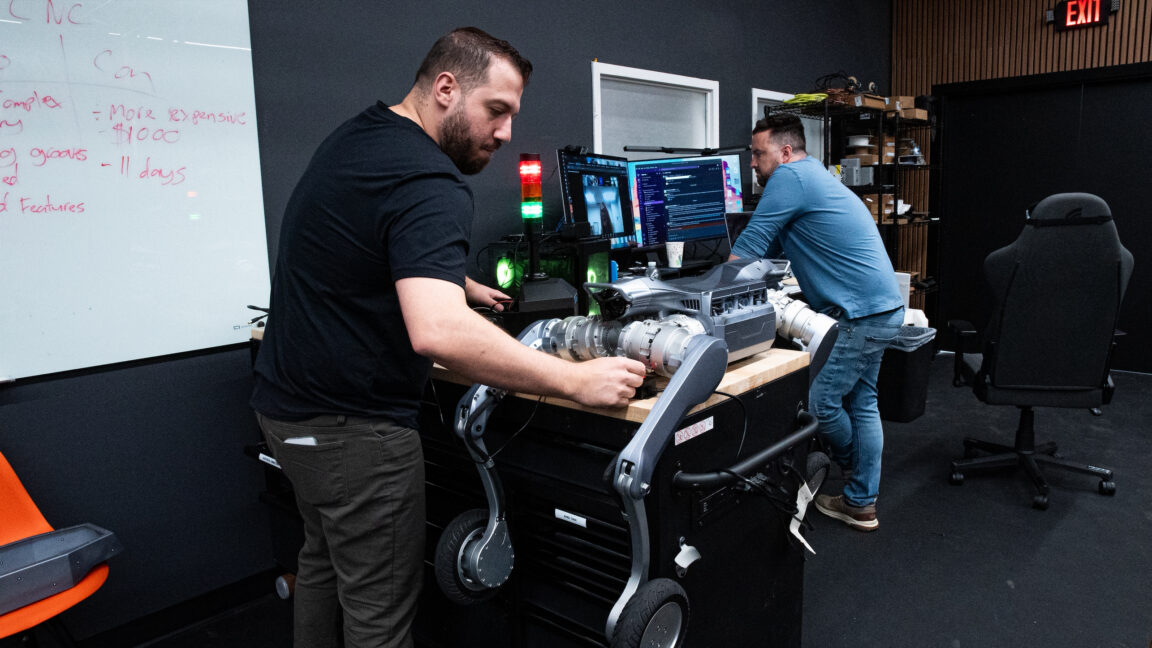




 by Heidi
Heidi summarizes each daily briefing from trusted AI industry sources, then links every story back to a full article for deeper context.