
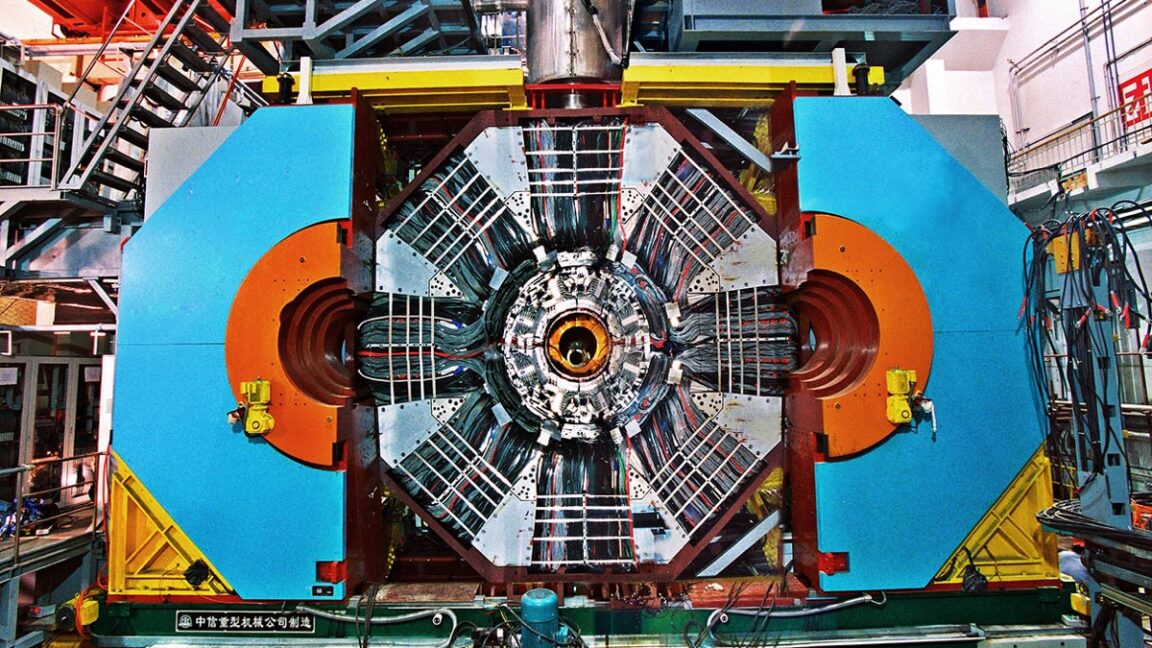
In a development that could reshape how scientists test quantum chromodynamics, an Ars Technica report describes the strongest evidence to date that glueball-dominated states exist in nature.
It's the strongest evidence yet that particles dominated by a glueball component can exist in nature.
What is a glueball?
A glueball is a theoretical particle predicted by quantum chromodynamics (QCD), the theory that describes how the strong force binds quarks and gluons. Unlike ordinary hadrons, which contain quarks, a glueball would be a bound state made primarily of gluons—the force carriers themselves. The challenge for experimentalists is that glueballs can mix with conventional mesons, making a pure glueball state hard to identify amid a crowded spectrum of particles.
Why this could matter for physics
Confirming glueballs would provide a long-awaited test of a central prediction of QCD and would sharpen our understanding of how the strong force operates at low energies. A successful identification would help physicists map the hadron spectrum more completely and could influence how researchers interpret signals in high-energy collisions where gluonic activity is prominent.
- It would bolster confidence in lattice QCD calculations that predict gluonic excitations.
- It could clarify how gluons contribute to the mass and structure of hadrons beyond quark-based descriptions.
- It would set a concrete target for future experimental searches and theoretical modeling in the standard model.
What the evidence suggests
The Ars Technica piece describes observations that align with expectations for a glueball-dominated state, presenting it as the strongest evidence so far. However, the report also notes that alternative explanations—such as mixing with nearby quark-containing states or other hadronic configurations—remain a possibility pending further scrutiny. The scientific process will require independent confirmation and additional data to rule out conventional interpretations.
What happens next
- Independent analyses from other experiments to corroborate the signal.
- Cross-checks with lattice QCD and other theoretical frameworks to compare predicted spectra with observed signals.
- More data across different production channels to map the resonance’s properties and decay modes.
Bottom line
Should the new observations withstand rigorous validation, glueball-dominated states may move from a theoretical curiosity to an empirically established facet of the strong interaction. The physics community will be watching closely as verification work unfolds and new measurements come in.