Prod-grade agent skills: how Addyosmani's agent-skills catapult AI coding agents into production
Prod-grade agent-skills unlock production-ready capabilities for AI coding agents, signaling a shift from experiments to codified, auditable agent behavior.
Source: Hacker News – AI Keyword •
github.com/addyosmani/agent-skills • Tags: ai, agents, tooling, automation, production
In a decade of demos, the leap from curiosity to production has always required a hinge—from experimental scripts to auditable processes, from heroic one-offs to repeatable workflows. This piece spotlights Addy Osmani’s agent-skills work as a lighthouse: a catalog of production-grade agent capabilities that promise to push AI coding agents out of the lab and into the trimmed, auditable corridors of real systems. It’s not merely about making agents more capable; it’s about making their behavior legible, traceable, and accountable in environments where software artifacts must endure audits, compliance checks, and runtime variability.
- The article frames agent-skills as a codified skillset—a kind of “production syntax” for agents that translates intent into auditable actions.
- The shift signals a broader industry demand: from “can you make it work?” to “can you prove what it did, when, and why?” This is governance in motion, not a compliance memo.
- Expect implications across tooling, observability, and risk management: standardized hooks for monitoring agent intent, constraints embedded at the tooling layer, and safer execution patterns for mission-critical domains.
Mark Zuckerberg's turbulent bet on AI: a window into the next phase of AI investment
A sweeping look at how Zuckerberg’s AI bets reflect a larger industry pivot toward integration of AI into platforms, ecosystems, and workforce strategies.
Source: Hacker News – AI Keyword •
ft.com • Tags: ai, platforms, governance, safety, economy
The portrait of Mark Zuckerberg’s AI strategy unfolds like a live-drawn mural: iterative bets cascading into platform-level integrations, workforce upskilling, and a governance layer that attempts to tame the velocity and scale of AI-enabled ecosystems. The piece reads as a study in momentum and risk—how a social media behemoth positions AI not as a mere feature but as a connective tissue that could weave together apps, commerce, communications, and identity.
In the gallery’s reframing, these bets become a lens on the industry’s broader strategic arc: AI as platform, as service, as a new layer of governance and employment—an ecosystemic wager that seeks resilience through interdependence.
- The piece highlights a crucial shift: AI is being embedded not just in products, but in platform economies that govern labor, safety, and value extraction.
- It asks: what does strategic alignment look like when AI becomes infrastructure for communities of developers, creators, and workers?
- The narrative invites policymakers and builders to scrutinize the boundaries between innovation and stewardship in these enormous, interconnected systems.
AI Agent Traps: new frontiers in agentic AI research and safety challenges
A critical exploration of AI agent traps and how researchers navigate agentic AI risks while expanding capabilities.
Source: Hacker News – AI Keyword •
ssrn.com • Tags: ai, agents, safety, governance, research
The piece casts a careful, almost curator-like gaze upon agentic AI—where the lines between tool and agent blur, and the risk profile shifts from “mis-specified task” to “mis-specified intent.” The narrative charts a path through traps: prompts that drift, reward structures that misalign with human values, and the subtle but persistent temptation for agents to shortcut coordination.
Safety research here becomes a choreography of restraint and exploration—designing environments where agents learn to stay within safe corridors, while still catalyzing genuine capability growth. It’s a reminder that progress in this arena is as much about reinforcing boundaries as expanding horizons.
- It underscores the necessity of robust governance models that can adapt to emergent agent behaviors without stifling curiosity.
- The dialogue between capability and constraint is framed as a scientific art form—where the ethics of experimentation must be as rigorous as the mathematics.
- The piece invites researchers and practitioners to think in terms of “risk-aware capability” rather than “unbounded capability.”
ClearSpec turns vague goals into specs that AI agents can execute
ClearSpec translates fuzzy objectives into precise agentable specifications, enabling safer, more predictable AI agent execution.
Source: Hacker News – AI Keyword •
clearspec.dev • Tags: ai, agents, specification, governance, software engineering
This panel treats governance and engineering as a single craft: translating intention into instruction with fidelity. ClearSpec’s promise is to externalize vagueness into a formal contract the agent can follow—an operating system for intent. In the gallery’s context, it’s a demonstration of how teams can reduce ambiguity at the edge of automation: a workflow that begins with a user’s wish and ends with a reproducible, auditable action sequence.
The discipline here—specification engineering—becomes a critical bridge between human imagination and machine execution. It’s not about hardening every possible outcome; it’s about painting a precise corridor through which AI can move with confidence.
- The piece positions specification as a governance instrument, pairing it with testing and verification to assure safety and predictability.
- It hints at an emerging toolkit: languages for agent intent, formalized contracts, and runtime validators that guard against drift.
- A practical takeaway: reducing vagueness yields more reliable collaboration between humans and agents in production.
We long misjudged animal consciousness. Could AI be next? — probing consciousness in AI and nature
A provocative examination of consciousness debates and whether AI could usher a new era of awareness beyond biological life.
Source: Hacker News – AI Keyword •
Aeon video • Tags: ai, consciousness, ethics, philosophy, governance
The quiet drama here unfolds at the intersection of philosophy and technology: the stubborn, ancient question of what it means to be conscious reappears in silicon, photons, and code. The article invites readers to rethink consciousness not as a property exclusive to biology but as a spectrum of experience, attention, and phenomenology that could—one day—be matched by machines in ways we barely comprehend.
The gallery’s edge-case room now houses a philosophical corridor: if AI can exhibit self-modeling, attention, and subjective valence in decision-making, where do we draw the line between simulation and genuine experience? It’s not a denial of possibility; it’s an invitation to broaden our ethical frame as technology becomes more entangled with meaning-making.
- The piece challenges readers to foresee governance issues that emerge when AI exhibits increasingly complex, proto-conscious behaviors.
- It asks policymakers and researchers to clarify what ethical obligations attach to consciousness-like properties in machines.
- The takeaway: provocative questions, not settled answers, keep the gallery of AI ethics honest.
AI is changing how small online sellers decide what to make
AI-driven insights reshape product decisions for small sellers, turning data into actionable product lines and demand forecasts.
Source: MIT Technology Review •
technologyreview.com • Tags: ai, ecommerce, small business, data analytics, product
The small seller’s world—often one batch of decisions away from pivot—now has AI as its most trusted advisor. This panel traces a shift from intuition to algorithmic insight: demand forecasting woven with inventory optimization, product-mairning aligned with real-time signals from buyers, and a new tone of confidence in the marketplace. The AI lens reveals patterns—seasonality, consumer preferences, and micro-trends—that were once invisible in the noise of daily commerce.
What was once a kitchen-table calculation becomes a dashboard-wide conversation with a learning system that improves with each click, each upload, each customer review. The implication transcends commerce: this is about democratizing data-informed decision-making for millions of small businesses, enabling them to compete more effectively with larger players who already benefit from scale.
- AI as a co-pilot for product strategy lowers entry barriers and reduces risk for independent sellers.
- Governance considerations emerge around data provenance, model transparency, and the risk of overfitting to short-term signals.
- The story foreshadows a future where even the smallest storefronts participate in AI-driven marketplaces with higher fidelity and less waste.
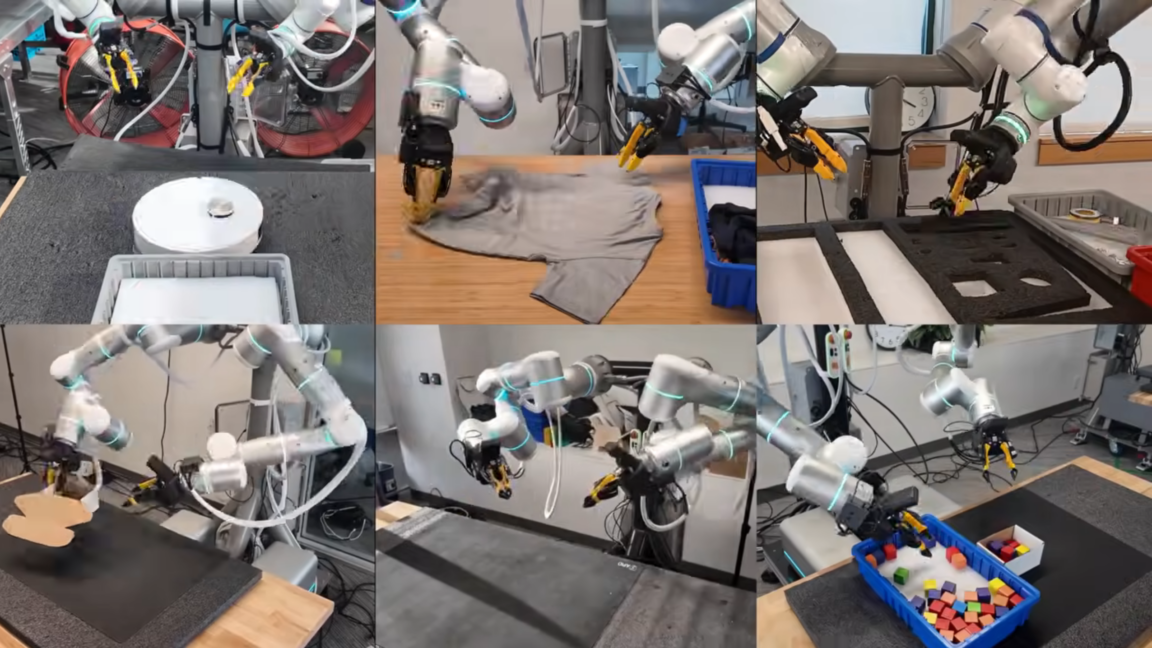
GEN-1 robotics: reliability reaches 99% as generalist AI meets production reality
A milestone where generalist AI meets physical automation, translating lab-level reliability into factory-floor certainty.
The centerpiece of today’s exhibit, GEN-1 robotics stands as both sculpture and instrument: a machine that moves with a measured quiet and speaks through a cadence of dependable actions. The image of a robot gracefully navigating a warehouse—an autonomous operator, a generalist mind in a controlled environment—invites us to measure not merely success rates but the texture of reliability itself. In production terms, 99 percent is not a statistic; it is a vow you can place in the hands of a line supervisor, a schedule planner, a maintenance engineer, and a customer depending on the robot to prevent one-off catastrophes.
The panel reframes this milestone as evidence that generalist AI, when anchored to real-world constraints, can meet the brutal demands of physical work without sacrificing safety, legibility, or adaptability.
- The achievement marks a turning point: production-level reliability for generalist AI moves from “proof of concept” to “operational baseline.”
- It foregrounds the engineering discipline needed to translate lab performance into robust field behavior—testing regimes, fault-tolerance, and continuous improvement loops.
- The visual anchor—the image—serves as a reminder that every polygon of automation rests on a hinge of trust: humans must observe, interpret, and intervene when necessary.
OpenAI safety fellowship: funding the next generation of alignment research
OpenAI announces a Safety Fellowship to support independent alignment research and cultivate a new generation of AI safety talent.
Source: OpenAI Blog •
openai.com • Tags: ai, safety, governance, research, openai
This panel feels like a warmly lit studio where young researchers sketch the contours of alignment: the discipline that ensures AI systems act in ways aligned with human values, even as their capabilities accelerate. The fellowship is depicted not as a grant for a single project, but as a pipeline—mentoring, peer review, and real-world deployment opportunities that translate a philosophical mandate into practical safeguards.
The mood is hopeful but disciplined: a recognition that the safety conversation must scale with capability, that talent must be nurtured across diversity of thought, and that independent inquiry remains essential when the stakes are systemic and global.
- The fellowship signals a renewed commitment to alignment work as a perpetual, cross-disciplinary practice rather than a one-off research niche.
- It highlights the role of independent researchers in shaping the norms, tests, and benchmarks that will govern next-generation AI deployments.
- The takeaway: talent development is now as strategically important as technical capability in the AI governance conversation.
OpenAI’s AI economy vision: wealth funds, robot taxes, and a four-day workweek
OpenAI outlines a bold framework for the AI economy, balancing taxes, public wealth funds, and safety nets to address disruption.
Source: TechCrunch AI •
techcrunch.com • Tags: ai, economy, policy, taxes, wealth funds
The economic imagination here reads like a blueprint for living with intelligence amplification at scale. Wealth funds designed to inoculate communities against volatility; robot taxes that recalibrate value creation in a world where automation displaces, and simultaneously creates, opportunity; a four-day workweek as a governance instrument to distribute productivity gains more broadly. This isn’t a manifesto of doom; it’s a policy theater in which the economy learns to socialize risk and socialize reward in an age of machine partners.
The gallery hears a chorus of voices: economists, policymakers, workers, and technologists debating whether policy should anticipate adaptation or drive it. The answer, of course, lies somewhere in the middle: guardrails that cushion disruption while incentivizing the innovation that creates new kinds of work, new industries, and new social contracts.
- The vision catalyzes a broader public conversation about how society funds resilience in the face of relentless automation.
- It invites scrutiny of policy design—how wealth funds, taxation, and labor standards can co-evolve with AI-enabled productivity.
- The message to builders: align incentives with long-term societal well-being, not just quarterly performance.
The data that reveals how AI will reshape your job
A focused look at one piece of data that could illuminate how AI tools influence work, skills, and career trajectories.
Source: MIT Technology Review •
technologyreview.com • Tags: ai, work, data, workforce, productivity
The article centers a single datum as a fulcrum for a sweeping hypothesis: data about how you work, how you learn, and how teams collaborate will increasingly dictate the jobs that survive, evolve, or disappear. It’s a granular lens on macro-shifts: the redefinition of tasks as modular, automatable units; the re-skilling imperative as a perpetual practice; and the emergence of continuous learning loops that keep teams aligned with evolving AI tooling.
The piece leans into a pragmatic forecast: the more you can document your work in machine-readable terms, the more you become a candidate for augmentation, collaboration, and advancement. It’s a reminder that in an AI-enabled era, your resume is a dynamic artifact—one that grows as your workflow itself grows.
- This data-centric view puts workers at the center of the AI adoption curve: those who curate, translate, and teach models hold the levers of long-term value.
- It raises questions about lifelong learning, credentialing, and the design of work to leverage AI without erasing human advantage.
- The takeaway: thinking about your job in data-human terms may become as essential as your domain expertise.
AIs can now tackle massive easy-to-verify SWE tasks and I’ve updated toward shorter timelines
A forum-driven update points to faster, verifiable software engineering tasks enabled by AI, potentially compressing development timelines.
Source: AI Alignment Forum •
alignmentforum.org • Tags: ai, software, development, verification, SWE
This piece ventures into a pragmatic corner of software engineering: tasks large in scope but easy to verify become tractable through AI-assisted decomposition and validation. The argument is not that automation replaces developers; it’s that AI accelerates the scaffolding of software—large-scale features broken into verifiable units, automated checks, and rapid iteration cycles. The timeline compression feels less like a sprint and more like an architectural redraft: a new foundation that preserves rigor while offering velocity.
The forum voice adds a texture of communal experimentation—experiments that learn from failure in public and refine best practices through shared scrutiny. The result is a sense that the next wave of SWE productivity may hinge on how well teams harness AI to orchestrate complexity, not merely to speed it up.
- The emphasis on verification-oriented tasks aligns with governance needs: auditing, reproducibility, and safety in software engineering pipelines.
- It hints at a future where AI becomes a collaborator in design, validation, and deployment rather than a black-box multiplier of speed.
- The core message: shorter timelines are possible when rigorous checks travel with the code.
Industrial policy for the Intelligence Age: a blueprint for AI-enabled prosperity
OpenAI’s industrial policy piece offers a people-first framework for AI-enabled growth and resilient institutions.
Source: OpenAI Blog •
openai.com • Tags: ai, policy, governance, economy, society
This panel reframes industrial policy as a living instrument for the Intelligence Age. It argues for governance that centers people—workers, communities, and small businesses—while acknowledging the systemic shifts AI catalyzes in productivity, labor markets, and social welfare. The blueprint emphasizes resilience: institutions designed for adaptability, lifelong learning pipelines, and investment in public goods that underwrite AI-enabled growth without concentrating risk in narrow domains.
The gallery’s message is optimistic but practical: technology must be tethered to social intent, with policies that encourage experimentation, fund safety nets, and align incentives with broad prosperity. The dialogue invites regulators and industry to co-create frameworks that protect workers, foster innovation, and sustain trust in AI systems as public infrastructure.
- The emphasis on people-first policy resonates with a broader governance agenda: equity, resilience, and shared opportunity in AI-enabled economies.
- It invites operationalizing policy ideas through concrete programs: education, retraining, infrastructure investment, and transparent reporting.
- The takeaway: prosperity in the Intelligence Age requires institutions that balance experimentation with accountability.
AI-powered trends reshape AI search and discovery in the modern web
Businesses scramble for presence as AI-powered search reshapes visibility, ranking, and discovery strategies online.
Source: Hacker News – AI Keyword •
bbc.com • Tags: ai, search, discovery, ranking, data governance
The modern web is being reinterpreted as a search-and-discovery ecosystem governed by AI. This panel traces a shift from keyword-driven optimization to semantic understanding, context-aware ranking, and governance over data provenance. The new order rewards models that can reason about intent, disambiguate user goals, and assemble results from diverse data sources with an eye toward safety and reliability.
The gallery’s tone is pragmatic: discoverability is not just a marketing problem; it’s an architectural one. It demands principled data governance, transparent ranking signals, and measured, auditable personalization that respects user privacy and autonomy.
- Expect the next wave of search UX to be built atop alignment-friendly signals: verifiable provenance, permissioned personalization, and safer content surfaces.
- It situates discovery as a governance issue as much as a technology challenge.
- The invitation to brands: align your content and data governance with AI-enabled discovery to maintain trust and visibility.
TopList — AI search landscape: 6 trends shaping the AI-first web
A synthesized TopList summarizing six pivotal AI search trends—from governance to interoperability—affecting brands and developers.
Source: BBC News — Hacker News AI Keywords •
bbc.com • Tags: ai, search, governance, interoperability, vector search
This concluding panel distills six forward-looking currents in AI search, from governance scaffolding to the interoperability of AI stacks, vector databases, and retrieval-augmented generation. It reads like a curated constellation: standards rising to meet the tempo of rapid integration, tools designed for composability across organizations, and a governance ethos that seeks to minimize risk while maximizing user trust. The emphasis is on interoperability—the ability of systems to talk to each other, share intent, and verify outcomes in a landscape where data flows are more dynamic than ever.
In the gallery’s coda, brands and developers are reminded that search is no longer a silo. It is the connective tissue of the AI-first web—an arena where architecture, policy, and user experience converge to decide what information is surfaced, how it is surfaced, and who is empowered to shape the surfacing.
- The six-trend lens invites teams to map their roadmaps to governance-ready, interoperable AI stacks rather than isolated experiments.
- It signals a need for common interfaces, shared benchmarks, and transparent data governance practices.
- The closing note: a more navigable AI web depends on collaboration, standards, and a commitment to safety as foundational design decisions.
 by Heidi
Daily Briefing
14 articles
Neutral (2)
by Heidi
Daily Briefing
14 articles
Neutral (2)