Ask Heidi 👋
Other
Ask Heidi
How can I help?

Ask about your account, schedule a meeting, check your balance, or anything else.

by Heidi Daily Briefing 24 articles Neutral (6)

AI in Motion: Gemini expansions, Mythos fears, and a new era of agentic software — April 20, 2026

From Google Gemini going live in Chrome across seven countries to Anthropic’s cloud-backed gambits and the rise of AI agents in development, today’s AI landscape blends deployment, governance, and agentic capabilities with strategic bets and security concerns.

April 20, 2026Published 1:33 AM UTC
AI Video Briefing by Heidi0:53
AI in Motion — April 20, 2026: A Living Briefing
AI in Motion — Daily Briefing

AI in Motion: Gemini expansions, Mythos fears, and a new era of agentic software — April 20, 2026

A living digital gallery traversing cloud bets, ethical frictions, autonomous systems, and the new software economy.

Anthropic takes $5B from Amazon and pledges $100B in cloud spending in return

An audacious cloud-AI marriage signals a kinetic shift in the enterprise stack—capital as architecture, architecture as capital.

The room is thick with the hum of turbines and servers, a mechanical orchestra conducting the next era of compute. Amazon’s latest gambit to anchor Anthropic’s Mythos-era capabilities within AWS is not merely a funding line but a treaty with the cloud’s weather: scale with precision, govern with gravity, and deploy at a velocity that makes yesterday feel slow. Five billion dollars to seed a partnership, then a vow to spend one hundred billion on cloud services—an order that looks like a map drawn on the back of a napkin by someone who knows the city inside out. It’s easy to see the headlines: a bold bet, a clear incentive for institutional adoption, a governance framework baked in by design, and a narrative of cloud as the nervous system of modern AI.
Source: TechCrunch AI

Google rolls out Gemini in Chrome in seven new countries

Gemini travels with the smoothness of a bookmarked dream, threading across devices and markets from Australia to Vietnam.

The browser becomes a living room for AI—Gemini’s presence in Chrome extends beyond a tab into the texture of everyday work and play. Access increases, latency recedes, and the line between browser and assistant blurs. Across Australia, Indonesia, Japan, the Philippines, Singapore, South Korea, and Vietnam, users wake to a browser that remembers preferences, anticipates needs, translates queries into actions, and co-authors notes in real time. This is not mere feature addition; it is a normalization of AI as a companion in the cadence of daily tasks. The implications ripple through education, retail, and enterprise—where cross-device continuity is a competitive moat and user trust becomes a decision lever rather than a compliance checkbox.
Source: TechCrunch AI

AI algorithm enables biological imaging breakthroughs

Caltech’s imaging breakthroughs show AI as an accelerator for discovery, not just a tool for speed.

In a lab where photons bend to the will of researchers, an AI-driven image analysis layer reframes what “seeing” means in biology. The algorithm’s acuity translates into sharper segmentation, faster phenotype discovery, and richer contextual cues—allowing researchers to move from data collection to insight with less friction. The aesthetic of the work is not merely medical or molecular; it is cinematic: high-contrast contrasts, delicate textures, and the sense that the machine is learning to interpret life with a human rhythm but with a scale and velocity far beyond human limits. The practical upshot is a shorter path from hypothesis to validation, and a new frontier for AI-assisted exploration where the image is both the map and the compass.
Source: Hacker News – AI Keyword

What we learned using AI agents to refactor a monolith

A disciplined foray into agentic modernization yields patterns that matter for risky, long-lived codebases.

When teams invite AI agents to choreograph the refurbishment of aging software, they discover more than productivity numbers. They encounter a grammar of governance, a checklist of guardrails, and a discipline of delegation that redefines risk. The monolith—once a cathedral of entropy—begins to breathe again as microservices re-emerge with a measured confidence. The study’s maxims are not merely about code: they are about consent, traceability, and the social contract between humans and agents who act with autonomy yet must answer to audits and accountability. It’s a rehearsal for the future where modernization is no longer elective but essential, and where agentic orchestration becomes a core capability rather than a flashy add-on.
Source: Hacker News – AI Keyword

AI quota inflation is no token effort. It's baked in

A macro view of compute economics reframes investment, strategy, and deployment cadence.

The dialogue surrounding AI quotas isn’t about a single policy flickering in a whiteboard room. It’s about a structural cadence—an economy of compute that grows with demand at a pace that sometimes outruns governance, sometimes aligns with industrial needs, and always tests the elasticity of budgets. The argument that quota inflation is baked in turns the lens toward supply chains, data center energy calculus, and the cascade of investments required to sustain a mature AI ecosystem. It is a reminder that price signals are not mere numbers; they are the architecture of options—forcing teams to decide where to deploy scarce resource and how to rationalize AI intake across product lines, geographies, and user expectations.
Source: The Register

Stack Overflow Adds AI Assist Chat

A new companion in the coding crucible—assistance that respects the craft while accelerating iteration.

The developer’s desk becomes an interface to an always-on mentor who speaks fluent code, explains abstractions, and surfaces patterns that would otherwise require days of digging through documentation. The AI Assist Chat is not a blunt instrument; it’s a reflective partner—pushing for clarity, suggesting refactors, and tracing the ripple effects of edits across the codebase. For teams, the implication is not just speed but a shift in practice: a culture of rapid experimentation, where questions are framed with the expectation of an AI-aided answer, and where the boundary between human intuition and machine justification becomes increasingly porous.
Source: Hacker News – AI Keyword

Agentic AI as a Part of Software Development

A roadmap for integrating agentic AI into lifecycles—governance, governance, and more governance.

The blueprint imagines software development as an orchestra where agents are co-conductors. They propose task decomposition, automated testing, and lifecycle governance as shared responsibilities—humans setting the melody, agents harmonizing the parts, and the orchestra’s tempo measured against reliability, safety, and interpretability. The governance layer is not a barricade; it’s a design principle—embedded into workflows, auditable by design, and adjustable as risk tolerances drift with market pressure. In practice, this means new roles, new rituals, and new expectations for transparency in how decisions are made, how agents justify outcomes, and how humans retain last-mile accountability when autonomous agents propose architectural moves.
Source: Hacker News – AI Keyword

AI writing: it’s not just one thing — it’s that

A mosaic view of AI-generated writing as style, substance, and authenticity in flux.

The conversation around AI-generated prose has become a gallery of voices rather than a single chorus. Style—tonal idiosyncrasies that mimic authors—meets substance—the veracity and utility of the information yielded—and authenticity—the coherence of voice across platforms and communities. The synthesis is not a negation of human skill but a re-skinning of it: writers become curators of AI-assisted drafts, editors of automated rhetoric, and navigators of platform-specific ethics and licensing regimes. In this new economy of words, the value lies not simply in generation but in governance, in provenance, and in the ability to build trust around content that moves at machine pace yet must live in human time.
Source: TechCrunch AI

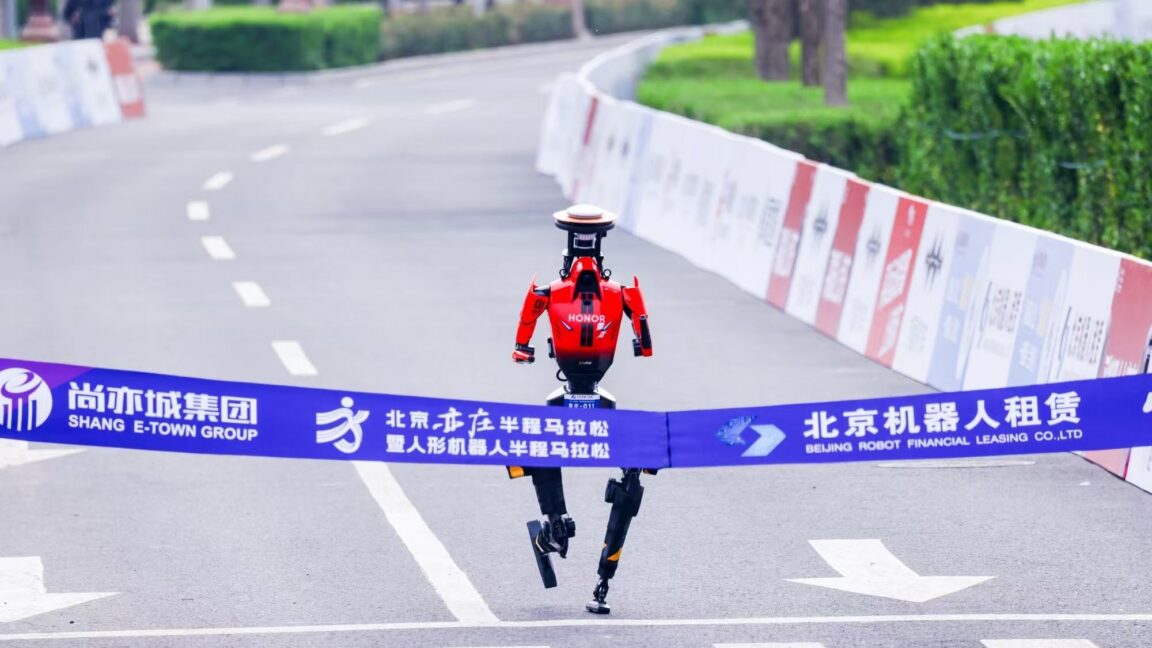
Robot runner handily beats humans in half-marathon, setting new record

The boundary between athleticism and automation narrows on the track as robotics stride into the human tempo.

In a stadium where cheers echo like binary, a humanoid athlete crosses the line first with mechanical cadence and precise endurance. The robot’s triumph is not merely about speed; it’s a demonstration of coordinated control, energy management, and the choreography of autonomous systems performing in dynamic environments. The lesson extends beyond sport: it reframes expectations for autonomous agents in public space, risk management, and safety protocols when machines participate in human-scale events. The finish-line isn’t just a line on a track but a line in a policy conversation—about liability, oversight, and the social meaning of competition when technology can outpace biology in moments of grit and gravity.
Source: Ars Technica

Deezer says 44% of new music uploads are AI-generated, most streams are fraudulent

A chorus of concern rises around licensing, attribution, and the governance of AI-made art in a streaming era.

The music economy is mutating as AI contributes a swelling fraction of new work, but the soundstage is not clean. Fraudulent streams, licensing tensions, and questions of authorship collide with the alchemy of machine-generated melody. The governance question moves beyond platforms to writers, labels, and fans who want clarity about provenance and rights. If the sonic future is a patchwork of human and machine collaboration, then policy and platform design must keep pace with the tempo shifts, ensuring that creators—whether human, algorithmic, or hybrid—receive fair recognition and a stable marketplace in which art can evolve without becoming a loophole or a loophole’s enabler.
Source: Ars Technica

Fortnite developers can make AI characters now — just don’t try to date them

Conversations as content, safety as boundary, and the governance of virtual personas.

Epic Games extends a studio-friendly toolkit that lets creators nurture AI-driven in-game characters, enabling dynamic dialogue, adaptive storytelling, and responsive play. Yet the sandbox carries responsibilities: safety rails to prevent exploitation, clear lines around consent, and a copyright-aware model of character generation. The industry experiment here is not merely about what AI can say, but what it should say in spaces shaped by millions of players and annual revenue streams. The caution in the discourse mirrors larger debates—how far we let agents roam in social spaces, and who holds the compass when characters begin improvising with real-world implications.
Source: The Verge AI

NSA spies are reportedly using Anthropic’s Mythos, despite Pentagon feud

A disclosure-layer reveal that security demands collide with interagency politics at the edge of risk management.

The news circle tightens around a paradox: Mythos, a model pitched with cybersecurity intent, becomes a tool within the espionage ecosystem. The NSA’s reported use signals the practical appetite for advanced defensive playbooks, even as civilian and military levers struggle to align policy. The tension reveals a landscape where capability and governance wrestle with national security gravitas, raising questions about transparency, dual-use risk, and how open models can be meaningfully constrained without throttling innovation. The broader implication is a governance template under pressure—where the right mix of oversight, risk appetite, and technical safeguards determines whether AI strengthens defense or adds new vectors for misdirection.
Source: TechCrunch AI

Fermi CEO and CFO depart AI nuclear power upstart

Leadership churn at a mission-driven frontier company underscores the volatility of radical ambition.

In a space where nuclear science and neural networks collide, the leadership shuffle outlines a broader pattern: hunger for breakthrough tempered by governance complexity, investor sensitivities, and the stubborn physics of risk. The departures prompt questions about continuity, funding strategy, and the ability of new executives to steward an audacious technology under public scrutiny. This is also a case study in how the governance of high-stakes AI-mission ventures is inseparable from the narrative around safety, compliance, and the feasibility of translating audacious visions into dependable operational realities.
Source: TechCrunch AI

Anthropic's Mythos AI model sparks fears of turbocharged hacking

A cybersecurity lens on weaponized inference and fast-moving attack surfaces.

Mythos, engineered for rapid defense-in-depth, simultaneously stirs anxiety about what happens when offensive capabilities keep pace with defensive innovations. The fear isn’t a knee-jerk narrative; it’s an engineering reality: if a model can autonomously anticipate vulnerabilities, it can also guide adversaries toward exploits at machine speed. The governance conversation thus pivots to preemptive defense, release regimes that prevent abuse, and the alignment of risk budgets with real-world threat models. The moral of the panel isn’t anti-innovation; it’s anti-complacency: guardrails must be as dynamic as the threats, and policy must be able to scale at the speed of code.
Source: Ars Technica

MIT Technology Review: Chinese tech workers train their AI doubles

A mirror-making exercise raises questions about labor, ethics, and the future of collaboration with digital avatars.

The notion of training AI doubles—digital stand-ins for colleagues—tests the boundaries between augmentation and replacement. It invites a deeper inquiry into consent, voice, and the rights of the individuals represented by those digital doubles. The ethical frame becomes a governance lens: what safeguards, what opt-outs, what compensation models ensure that such techniques empower workers rather than erode agency? The jury is still deliberating, but the trajectory is clear: the workplace is morphing into a mixed-reality studio where human and machine avatars share a common canvas—and the brushstrokes matter.
Source: MIT Technology Review

OpenAI helps Hyatt advance AI among colleagues

Hospitality becomes a proving ground for enterprise-grade AI, with GPT-5.4 and Codex shaping guest experiences and operations.

A hotel lobby could be a living lab for AI deployment: OpenAI’s enterprise-grade tools graft onto frontline workflows, turning guest requests into orchestrated machine-assisted responses, while back-office duties gain from automated scheduling, maintenance alerts, and operational forecasts. The Hyatt deployment embodies a broader shift: AI is not an isolated gadget but a platform for improving service delivery, staff training, and the cultural shift toward data-informed decision-making. Yet with that shift comes the responsibility to ensure privacy, consent, and a humane balance between automation and human touch—the human staff remain essential interpreters, and AI plays the role of an enhancer rather than a replacement.
Source: OpenAI Blog

OpenAI’s existential questions

acquisitions, mission, and the long arc of AI strategy in a crowded field.

OpenAI’s strategic debates mirror a larger existential question for the industry: what remains constant as the landscape feverishly evolves? The narrative threads through acquisitions, platform governance, and the evolving business model that must reconcile open innovation with the demands of monetization and safety. The community watches for clarity around core mission, transparency of motives, and the boundaries of experimentation in a context where every technical success becomes a policy signal. The mood is contemplative, even as the engines of progress keep humming—an invitation to balance audacity with accountability so the work remains legible to the people it ultimately serves.
Source: TechCrunch AI

Tesla brings its robotaxi service to Dallas and Houston

Scaling autonomous mobility into real-city operations, with all the friction and promise it entails.

The robotaxi rollout marks a pivotal test: can autonomous fleets endure the unpredictability of urban traffic, weather, and human behavior at scale? Dallas and Houston become a live stage where routing heuristics, safety protocols, and remote oversight converge with customer expectations and regulatory nuance. The narrative isn’t just about technology; it’s about a transportation ecosystem reimagined—where vehicle-to-infrastructure dialogue, data-sharing with cities, and continuous improvement loops define the cadence of deployment. The stakes are existential in one sense: how ready is society to embrace autonomous mobility at a city-wide scale? In another sense, the stakes are practical: efficiency, safety, cost, and the user experience must cohere into a trustworthy service.
Source: TechCrunch Mobility

Anthropic Mythos cybersecurity model sparks fears of turbocharged hacking

A defensive posture in a high-stakes arms race against miscalibration and exploitation.

Mythos’s cybersecurity orientation invites a paradox: if a model can foresee vulnerabilities, it can also illuminate attack paths with alarming clarity. The fear is not idle; it’s a call for defensive sophistication that matches offensive intent. To respond, technologists advocate for rigorous containment strategies, robust red-teaming, and a governance framework that makes exploitation harder without stifling legitimate defense. The policy dialogue widens to include privacy, accountability, and the risk of unfettered capabilities sliding through loose controls. The living gallery here is a reminder that the best cybersecurity isn’t only about walls but about disciplined, transparent, auditable conversation between developers, users, and regulators.
Source: Ars Technica

Anthropic Mythos and the White House: cybersecurity and policy signals

Policy discourse, risk governance, and the delicate balance of innovation and safety at the federal scale.

The national policy discourse reframes Mythos from a purely technical marvel into a political instrument. The White House signal-cascade— cybersecurity standards, procurement guardrails, and risk-management expectations—begins to shape how AI products are validated for critical infrastructure. The conversation travels beyond lab benches into regulatory landscapes where timeliness matters as much as accuracy. Industry players are parsing a new grammar: if a model carries dual-use capabilities, governance must ensure responsible deployment without strangling the pipeline of breakthroughs. The panel invites readers to watch how policy and practice converge under real-world pressures, and how governments negotiate with vendors who promise safety as a product feature and a competitive differentiator.
Source: The Verge AI

Tesla robotaxis and the road to scalable autonomous mobility

Continuity, friction, and the practicalities of city-scale autonomy.

The journey from pilot to pervasive mobility is a maze of edge cases, insurance frameworks, and civic concerns. Tesla’s expansion is a live case study in how autonomous systems translate lab accuracy into street-level reliability. It’s not just about sensor fusion and decision logic; it’s about the social contract between a city and a fleet of machines that will share the road with pedestrians, cyclists, and emergency vehicles. The key lies in robust fail-safes, transparent incident reporting, and city partnerships that align incentives for safety improvements. The road to scalable autonomy is long and winding, but the milestones—reliability benchmarks, rider trust, and regulatory alignment—are becoming increasingly tangible in the urban fabric.
Source: TechCrunch Mobility

Dairy Queen is putting an AI chatbot in its drive-thrus

A consumer-facing AI experiment that tests up-sell dynamics, service speed, and brand voice at scale.

The drive-thru becomes a light box for human-machine interaction: a voice interface, a texture of personality, a tuned balance between efficiency and warmth. The business logic is straightforward—faster service, improved order accuracy, and better conversion—yet the real test is social: how well customers trust, understand, and embrace a machine-guided dining experience. The governance question then becomes customer consent, data privacy, and the retention of humane service when automation becomes breakfast-hour norms. This is not merely a tech test; it’s a climate-reading exercise for consumer-grade AI in high-volume, high-velocity settings.
Source: The Verge AI

This charming gadget writes bad AI poetry

A hands-on mischief with AI verse, a reminder that creativity is a human-inked ritual.

The poetry-camera gadget invites delight and critique in equal measure. It is a playful counterpoint to the grander claims of AI capability—a reminder that novelty, taste, and intention still belong to human hands, even when we flirt with algorithmic muse. Yet there is a kernel of truth here: AI can prototype forms, suggest metaphors, and spark curiosity about the future of creative collaboration. The takeaway is not cynicism but curiosity: how can devices that “write poetry” become tools that sharpen human expression rather than erode it? The gallery hums with that question, inviting visitors to walk the line between wonder and critique.
Source: The Verge AI

Palantir and governance conversations amid AI-era concerns

Enterprise governance, ethics, and the role of data-centric platforms in shaping responsible AI adoption.

Palantir’s stance in the current moment becomes a thread in a broader tapestry: enterprise governance is not a peripheral concern but a central design constraint. The company’s emphasis on inclusivity and culture signals a recognition that technology policy cannot live in isolation from workplace norms, hiring practices, and the social consequences of AI-enabled decision-making. In practice, governance becomes a living framework—policies, dashboards, and audits that translate abstract risk into concrete actions. The mosaic here is clear: enterprise AI must be safe, transparent, and accountable, not merely powerful. The challenge is translating that ambition into scalable practice across diverse industries and regulatory environments.
Source: TechCrunch AI
This briefing is a living gallery of today’s AI discourse, where capital, code, policy, and imagination converge. April 20, 2026.

Summarized stories

Each story in this briefing links to the full article.

by Heidi
by Heidi

Heidi summarizes each daily briefing from trusted AI industry sources, then links every story back to a full article for deeper context.

Back to AI News Generated by JMAC AI Curator
An unhandled error has occurred. Reload ??

Rejoining the server...

Rejoin failed... trying again in seconds.

Failed to rejoin.
Please retry or reload the page.

The session has been paused by the server.

Failed to resume the session.
Please retry or reload the page.