
Overview
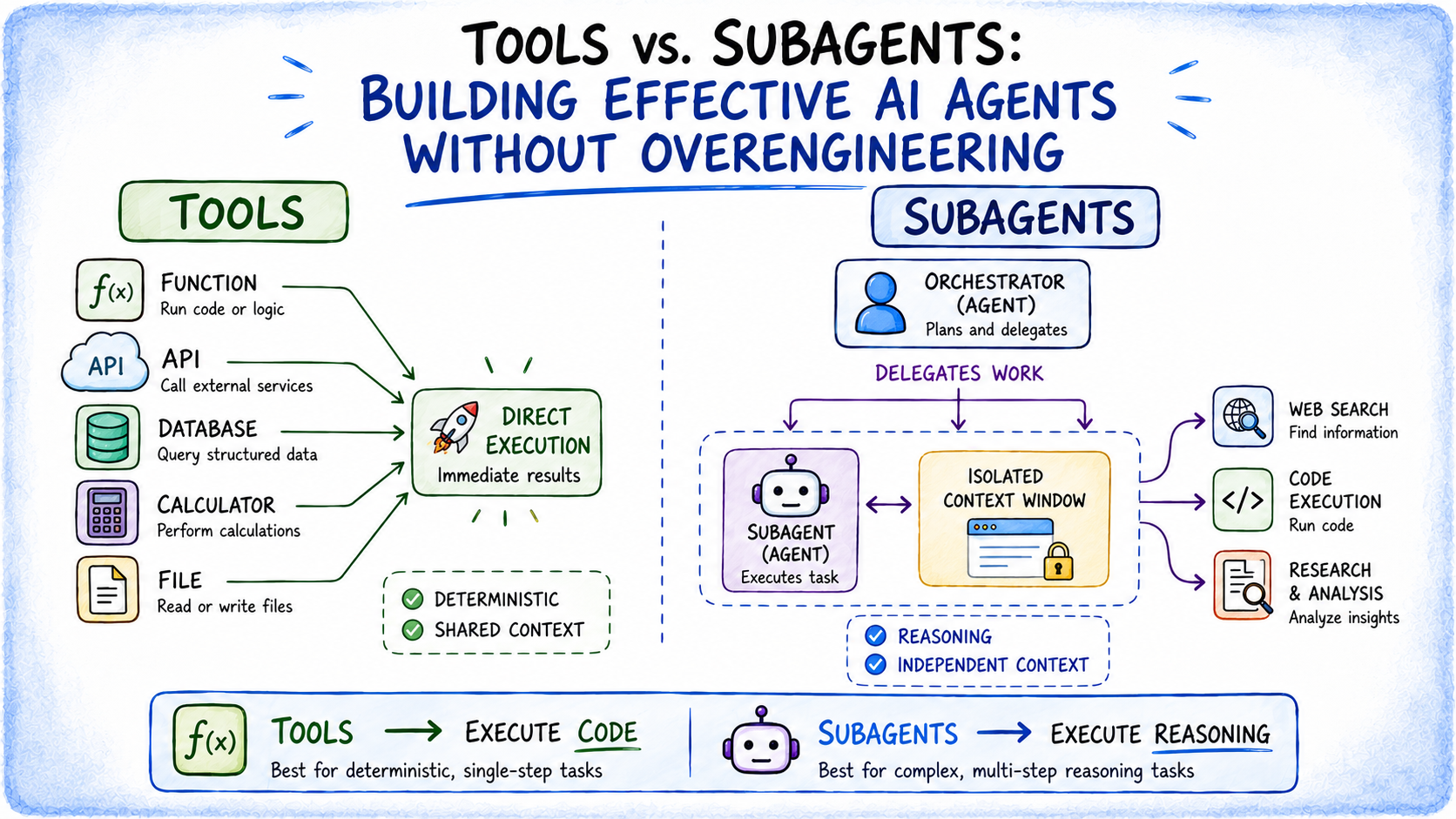
Designing AI agents often boils down to choosing the architecture that will lead to reliable behavior without unnecessary complexity. In Tools vs Subagents: Building Effective AI Agents Without Over-Engineering, the discussion centers on when to rely on simple, reusable tools that execute code versus embedding deeper subagents that reason, plan, and decide autonomously.
Tools execute code.
From the article by Machine Learning Mastery, the argument is that starting with tool-based approaches can help keep engineering lean while still enabling powerful behavior when combined with robust orchestration and safety measures.
Why tools matter
Tools, as components that perform concrete actions — fetch data, run a calculation, query a model — can be swapped in and out with minimal rework. This modularity reduces risk and speeds iteration because you can test each tool in isolation, monitor results, and modify interfaces without destabilizing the whole agent.
- Clear interfaces: Tools expose defined inputs and outputs, making it easier to verify correctness.
- Repeatability: Tool-based steps can be rerun, logged, and audited.
- Safety and containment: Keeping behavior inside well-scoped tools helps avoid unintended actions.
Where subagents fit without over-engineering
Subagents offer the potential for higher-level reasoning and dynamic planning, but adding them indiscriminately can lead to brittle systems that are hard to debug. The article argues for leveraging subagents judiciously, favoring minimal, well-scoped reasoning capabilities that complement tools rather than replace them.
- Purpose-driven reasoning: When a task truly benefits from planning, introduce subagents with explicit goals and stopping conditions.
- Guardrails over grandeur: Build constraints, budgets for action, and monitoring to catch deviations early.
- Incremental integration: Start with simple tool orchestration, then progressively add subagents with clear metrics for success.
Practical design guidelines
To build effective AI agents without over-engineering, the article promotes a pragmatic workflow:
- Start small: Begin with a small set of essential tools that cover the task, avoiding a monolithic agent.
- Modular architecture: Separate decision making from action execution; define robust interfaces between components.
- Observability: Instrument the system to capture decisions, tool calls, and outcomes for debugging and improvement.
- Safety checks: Implement containment strategies, rate limits, and rollback options to prevent harmful actions.
- Iterative refinement: Continuously test, measure, and refine the balance between tools and subagents based on real-world results.
Bottom line
The takeaway from the discussion is not to reject subagents nor to embrace them blindly, but to align architecture with the task at hand, favoring a tool-first approach that can gracefully incorporate subagents where they add measurable value. By focusing on modularity, safety, and clear interfaces, teams can deliver capable AI agents without the traps of over-engineering.